When The OS Swings: Custom AI Code 2nd Life for Vintage Beat Machines
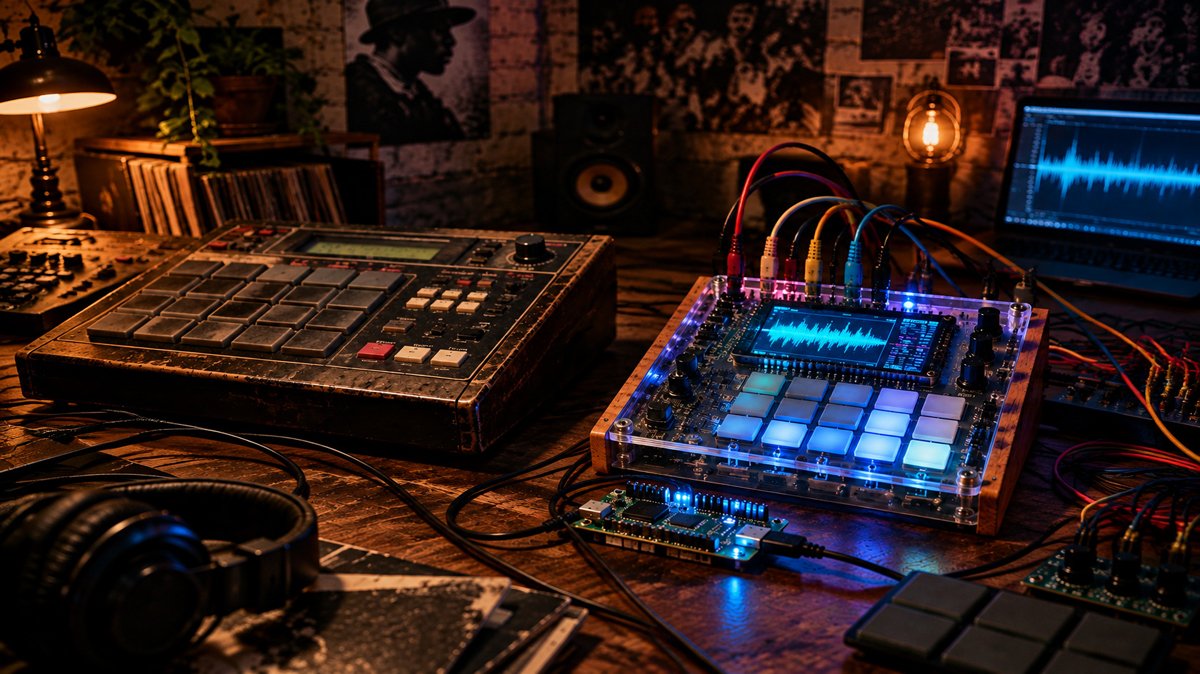
The old machines are getting new moves. Classic samplers are being nudged, patched, emulated – and reimagined by community developers, independent sellers, and official software teams. That does not mean a new wave of fully open, AI-generated operating systems has arrived. The current picture is rougher and more interesting: experimental firmware patches, independent coding projects, proposed platforms, file utilities, and an official plugin SDK all sharing the same conversation.
For beat makers, the appeal is obvious. Keep the tactile timing, the limitations, the converters, the swing, nostalgia and the ritual of the machines history. Add a detailed waveform view, faster chop workflow, mute groups, groove and swing – a new way to move sound through the box. Vintage tone combined with modern workflow is ideal for today’s hybrid recording studio.
Custom Beat Machine Firmware Flip
Vintage hardware culture has always been a little bit about defying the upgrade treadmill. A 2000XL or MPC3000 is not just a processor in a box; it is a physical language. The pad response, the screen, the menus, the storage limits, and the process all shape the beat. Now that language is meeting modern development tools. AI can help a developer inspect old code, sketch a feature, or move faster through repetitive work. Community builders can reverse-engineer workflows, test in emulators, and trade patches across forums. But faster coding does not automatically make a finished OS, and published source does not automatically make a project complete.
TERM | What It Means Here |
| AI Assisted Coding | A human-led project that uses AI during code development. The finished software can be a combination of human code and direction generated by AI. |
| Vibe Coded Firmware | A grass roots term for software built quickly with AI help or improvisational tooling. The developer needs to direct the project in regard to quality and openness. |
| Open Source Code | Code is made available under terms that permit inspection, modification, and sometimes redistribution. |
| Community Built Software | A third-party project shaped outside the original manufacturer, whether or not all code is open. Coders and creators get together on forums and build software together. |
| Replacement OS | Software intended to replace or substantially alter the machine’s operating system or firmware. |
From MPC floppy disks to vibe-coded firmware, beat makers are rewriting the rules without erasing the dirt. Extracting the best of both worlds. The new life being coaxed out of these machines is a patchwork, not a clean genre. It is hardware reverence with a soldering-iron mentality: preserve the feel, question the limits, and verify before you call it revolutionary.
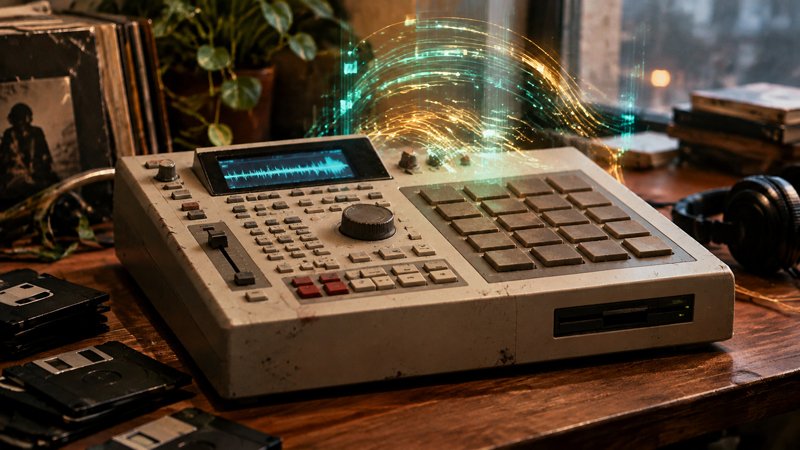
MPC2000 Mods by vubeats Version 2.1
vubeatz is a beatmaker, audio software developer, and sampler hardware modder based in Wrocław, Poland. He is best known in the music production community for creating vintage-inspired sampler apps, audio plugins, and custom operating system mods for classic Akai MPC hardware. Drawing from years of working with early digital hardware, vubeatz develops beatmaking apps and VST3/AU plugins focused on lo-fi character and fast workflows. Important contributions to the beat maker community.
Check out his 2.1 version OS suite that allows you to pick and choose the functions you want to add to your classic MPC-2000 or 2000XL. Version 2.1 includes twenty-one mods for Classic and fifteen for XL. Every mod is optional: tick the ones you want in the installer, and a mod that needs another one selects it for you. Features marked Classic apply to that machine only.
Version 2.1 includes twenty-one mods for Classic and fifteen for XL. Every mod is optional: tick the ones you want in the installer, and a mod that needs another one selects it for you. Features marked Classic apply to that machine only. Check out a few below:
- GRID VIEW: Edit a track on a grid of 16 pads and TIME CORRECT steps, as on later MPCs. In STEP, hold SHIFT and press F6 GRID. A pad places a step at the cursor and a second press removes it; MOVE, NUDGE and DELETE work on the selected step, and the grid stays on screen while the sequence plays.
- RESAMPLE: Render one pad, with its tune, envelope, level and pan, into a new sample. On ASSIGN, press OPEN WINDOW on Snd: set velocity and gate, and press DO IT.
- Sampling Mode: Give a new recording SP1200 or S900 character. On the sampling screen, OPEN WINDOW on Mode: selects a preset and sample rate; the MPC converts each recording before KEEP or RETRY.
Every mod is optional. The installer opens with the 1.8 set ticked. A mod that needs another one ticks it for you, and unticking a mod also unticks the mods that depend on it: Lazy chop needs REGIONS, the sorted file list needs Folders (Classic), and larger HFE needs FORMAT (XL). Some mods share the same memory, so the installer lets you tick only one of them. Check out his work.
Akai MPC 2000XL & The 2KXL PLUS Push
The MPC 2000XL is the kind of machine that makes a limitation feel like a signature. Its workflow is direct, its storage rituals are part of the culture, and its old-school sample handling still has function that modern menus do not always recreate.
That is the lane for 2KXL PLUS – an unofficial, experimental upgrade based on Akai OS 1.20. The reported version 1.3.2 was released October 7, 2026 with a reported price of $49. It is for the MPC 2000XL only and is not an Akai release.
The public feature description reports a more capable sample-editing pass:
- Chopping: Lazy Chop or live chop marking for getting from loop to slices with less menu diving.
- Control: Mute groups and reported filtering, including high-pass filtering.
- Sample tools: Normalization and other reported edits, with faster waveform handling described in the project material.
Those details should stay in the “reported” column. Public information does not establish how much of the code, if any, was AI-generated. The useful question is less “was AI involved?” then “does this OS build behave safely on the MPC 2000XL?”
New MPC 3000 Nostalgia & Functionality
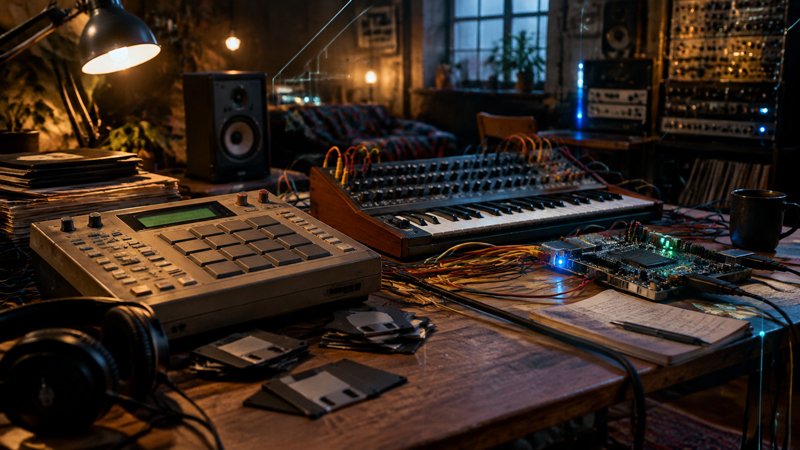
The MPC 3000 scene has never been short on strong opinions about feel. It is also one of the clearest places to see several different kinds of community software being developed for this classic machine. Beat makers such as Detroit’s J-Dilla, G Unit’s Sha Money XL and west coast music producer Dr. Dre have used the Akai MPC 3000 to craft countless musical masterpieces.
3K PLUS – an independent version 1.0 project. Its reported features include waveform editing, Lazy Chop, and track mutes. It can boot from floppy or a compatible emulator without rewriting EPROMs, a meaningful distinction for owners who want to test a new workflow without immediately committing to a hardware change, by flashing EPROMs.
Availability was uncertain in the latest reporting: a November 19, 2026 listing said downloads were temporarily paused. That is why “available,” “announced,” and “tested” should not be treated as the same status. Let’s give this time to cook a bit more.
The Surrounding MPC 3000 Ecosystem is Separate Territory:
- Vailixi 3.50 is an established EPROM replacement, not 3K PLUS.
- A separately announced 3.39.4 beta is another community development based on Akai 3.12.
- A proposed open-source “4.0” project was described by its developer as containing no AI code. It remains a proposal.
None of these are official Akai releases. They are third-party or community projects with different goals, different technical paths, and different levels of public verification. For a machine this storied, this scattered spread is not a footnote; it’s the current scene.
The Ensoniq ASR-10/R OS Offering
The Ensoniq EPS sampler came out in the 90’s and changed the game with technology way ahead of it’s time. A new “Ensoniq OS” developed for the classic sampler units is an underground-forum headline. Work is being done to bring classic MPC 3000 functionality to Ensoniq workstations. Giving beat makers the best of both sampler workflows and functions.
Check out Project Anthem – described by its creator as an OS project for Ensoniq ASR-10, ASR-10R, and ASR-88 hardware. The project aims to bring in MPC3000-style timing, chopping, and workflow ideas. The target is Ensoniq hardware – the timing claims are the developer’s claims, not independently verified here. That does not make the project irrelevant; it makes the wording important. Culturally, the cross-pollination makes complete sense. Each machine offering something to compliment the other.
Akai swing and Ensoniq sampling – occupy different corners of beat-making memory, but producers have always carried ideas from one box to the next. The community conversation is now doing that transfer in public: comparing feel, rethinking micro-chopping, and asking whether an operating system can preserve a machine’s character while borrowing a neighbor’s best tricks.
Behringer KICK & The Open OS Tease
Behringer KICK is an announced, unreleased MPC-inspired sampler prototype with published software source intended for customization and community development. That alone makes it a notable signal: manufacturers and hardware communities are testing what happens when the software layer is discussed as something users might shape. But “source published” is not the same as “everything is open.” An independent review of the available repository found missing build assets. That means the source should not automatically be read as a complete, readily buildable open hardware platform.
KICK is therefore best understood as a preview of where hardware may be heading, not a finished product and not a confirmed fully open platform. The distinction is especially important when AI-assisted development enters the headline. A prototype can be vibe-coded, source-published, or community-facing without being reproducible, supportable, or safe to modify.
For the underground, the tease is still powerful. Imagine a sampler whose personality is not locked away after launch, where users can extend the workflow instead of waiting for a distant official update. The next question is whether that freedom arrives with documentation, stable builds, clear licensing, and enough respect for the producers who will actually make music on it.
Behringer Kick Leak Breakdown | Is Behringer About to Take On The Akai MPC?
Akai MPC Open Plugins Not Open OS
Akai Pro’s modern MPC ecosystem adds another important layer to the story. MPC OS 3.10.1 was reported as released November 12, 2026 with support for external plugins and Akai’s official plugin SDK. The SDK’s getting-started documentation describes AI-assisted development. Opening the door for plugin makers: new instruments, effects, and integrations can be developed against an official extension path. An official plugin SDK opens plugin development. It does not make the proprietary MPC OS open source.
That is a meaningful upgrade for the ecosystem, but it is not the same thing as an open MPC operating system. The core OS remains proprietary in this framing. “Akai MPC Pro” can describe the broader modern MPC environment, but it should not be used to imply that the full operating system has been opened. Let’s give this time and see where it goes.
The independent MPFree OS project can be mentioned as an independent claim to an early open replacement for MPC One. It should not be presented as official Akai software, or as proof that Akai has released an open replacement OS. For developers, this is still a big cultural shift. The old box is no longer only a closed appliance or a nostalgia object; it is becoming a platform with carefully bounded extension points. The boundary is the story. The beat community will test the boundary moving forward.
Before You Flash Your Beat Machine
RECOVERY MINDED CHECKLIST
☐ Back up projects before changing firmware or testing unfamiliar software.
☐ Verify the exact model, OS version, storage method, and firmware compatibility.
☐ Retain a known-working recovery route, including the original firmware where possible.
☐ Understand that experimental firmware can crash, corrupt data, or cause malfunction.
☐ Do not treat a community build as safe merely because AI helped write some of its code.
Vintage hardware rewards curiosity, but it punishes casual assumptions. A build can be interesting, independently tested, and still be wrong for your unit. Keep the safety conversation plain: protect the session, protect the project, and do not turn a working sampler into an unplanned repair job. This is not an installation guide, and it should not be read as one. Before experimenting, read the project’s own documentation, confirm the recovery process, and decide what data you can afford to lose.
Imagine Future OS Sampler Mods: Akai S1000, S1100 or S3000, MPC60 or MPC60 II, MPC1000, MPC2000 or MPC2000XL, Emu SP1200, Emax I, Emax II or Emulator III, Ensoniq ASR10, 16 Plus or EPS, Sequential Circuits Studio 440.
Keep The Swing & Rewrite The Rules
The second life for vintage beat machines is not about making every old sampler behave like a new computer. It is about extending the conversation. 2KXL PLUS and 3K PLUS show how independent developers can improve iconic workflows. Akai MPC 4000 Tools shows why tooling and firmware should not be confused. Project Anthem shows how one machine’s ideas can travel to another platform. KICK hints at a future where the software layer is discussed before the product is even finished. Akai’s plugin SDK shows a more controlled version of openness. The common thread is preservation with pressure applied, beat machine evolution.
Keep the swing. Keep the commitment. Keep the strange little limits that force a producer to make a choice. Then ask whether new code can add capability without brushing off the dirt that made the box matter. For now, the crate-digger rule still applies to firmware: listen closely, check the source, keep the original, and never confuse a loud claim with a carefully finished record. Stay tuned for more contributions from the coalition of boom-bap producers and beat makers nationwide. Salute from Big Noise Radio & Audio!
Company Contact Info:
vubeats | Instagram | Website
Clevendon Road | Instagram | Website
Robbie Anthem | Instagram | Website
Tune into Big Noise Radio to check out world-class beat makers bringing music innovation and AI coding to the game!
Article: Danny Carter
Editor: Noiseman
Images: Big Noise Audio